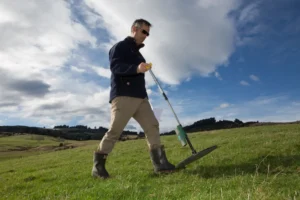
Mark is our Chief Information Officer and also leads the company’s five-strong IT/software development team. He has specialist expertise across the Microsoft Stack (Microsoft’s collection of software, platforms and cloud services), using it to design and implement web and mobile applications for clients. Mark is AbacusBio’s go-to person for initiating and driving major changes in programmes, procedures and methodology – for clients and within our own team. He has two decades’ commercial experience in New Zealand and London, including the health, energy, banking and agri-tech sectors. Mark joined the AbacusBio team in 2012.
Q: What attracted you to AbacusBio back in 2012?
A: My wife and I were just finishing up our OE in London and about to backpack around Europe for two months, before moving back to New Zealand.
I had an interview with AbacusBio, partly because the farming side interested me. My grandfather and father had run the family farm in Southland. The interview was done via cell phone, with me sitting on a park bench at night in Clapham Common. Neville (Jopson) and Jude (Sise) conducted the interview and they were pretty hard case for scientists.
Q: You are an expert user of the Microsoft Stack. how did that come about?
A: It evolved as my career progressed. When I started, as a junior software developer, I kept getting pulled into complex problems and challenges, such as identity, security and tenant design, as well as troubleshooting the “edge cases”, where multiple Microsoft services intersected. I can explain complex IT architecture in plain language and have a track record of delivering solutions that are secure, supportable and future-proof.
Q: Tell us about the AbacusBio IT / Software Development Team.
A: There are five in the team: three software developers, a Callaghan Innovation Intern and myself. Four of us are based in the Dunedin office and one works remotely in Christchurch.
Q: Describe some of the projects the team is currently working on.
Feed Optimization App: Developed by AbacusBio in collaboration with ICARDA (International Center for Agricultural Research in the Dry Areas) to optimize feeding strategies for small ruminants – sheep and goats – in resource-limited environments, such as Ethiopia and Tunisia. Its primary goal is to balance feed availability with energy and nutrient requirements to improve productivity and support smallholder farmers.
Forest Nursery App: A major initiative for a large-scale New Zealand forestry client to enhance its laboratory and nursery data systems, using Microsoft Power Apps and Power BI. It includes development of a scheduling system for lab workflows, integration of production data capture from polyhouse and container facilities, and advanced reporting analytics. The result is improved operational efficiency and better decision-making through integrated dashboards and instructional guidelines for staff.
Q: What IT tools does AbacusBio offer clients?
DTreo Plants and DTreo Animals. DTreo Plants is a cloud-based plant recording, monitoring, and reporting solution designed for horticulture and plant breeding programmes. It evolved from the legacy Gemview platform and is now a modern, intuitive web application built on Microsoft cloud technologies.
DTreo Animals is also cloud-based – on a SaaS (Software as a Service) platform –designed to support genetic evaluation and consulting projects in livestock systems. Originally conceived for smallholder farming systems, it enables recording individual animal data, performance monitoring, and pedigree tracking to improve breeding decisions and productivity.
Q: Cyber security: Your views on where it’s at and where it’s going?
Where it’s at? It has evolved rapidly, from a purely technical issue to a core business risk function. Boards are now involved and it’s great having them as part of the strategy and planning, and understanding the issues and risks. Implementation of security measures can be a fine balance between security and allowing users to be as efficient as possible when working with platforms.
Where it’s going? It will continue to be a battle of trying to keep defences up, making sure you continue training your users, and not being afraid to implement changes to keep ahead of the threats. We are already seeing attackers move faster than human response capabilities, so it will remain a challenge for businesses.
Impending threats: AI-driven attack acceleration, where attackers use AI to speed up, scale up and automate attacks, making traditional defences too slow to react. Attackers are also deploying self-directed AI agents that plan and execute attacks without human control.
Q: Where is AI taking us?
A: I recently finished an Institute of Directors course on AI governance for boards. From an IT perspective, there are plenty of pros and opportunities, but businesses do need governance practices around the use of AI. AbacusBio has invested in the use of AI. Our users have Copilot* licences in Microsoft 365 and we are seeing increasing productivity. The threat now is that many tools on the market involve shadow AI and unapproved tool usage. In summary, AI can bring efficiency, but can also expand the attack surface for businesses.
[* AI-powered, real-time productivity tool]
You can reach Mark at mteviotdale@abacusbio.co.nz.
Keep up to date with AbacusBio news, by subscribing to our newsletter HERE and following us on LinkedIn, Facebook and Bluesky