Featured Services
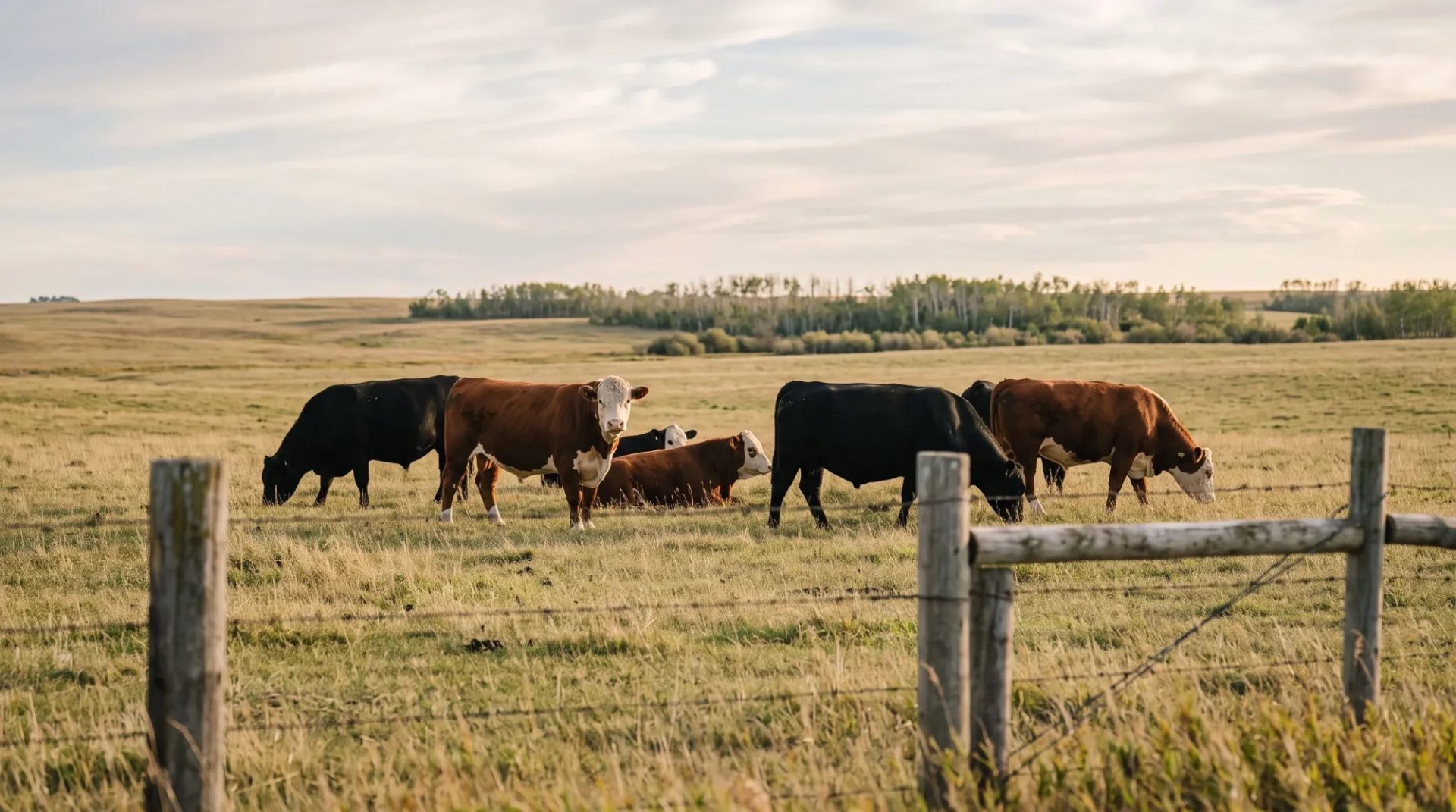
The Methane Reduction Sire Selection app generates a methane selection index that helps beef producers choose sires whose offspring are expected to emit less methane per kilogram of meat produced. It also generates an index for dairy producers to identify beef sires whose offspring are expected to emit less methane in a beef on dairy production system.
The index is calculated using current genetic evaluation results for traits known to influence methane emissions. When presented alongside conventional production and performance measures, the index allows producers to consider the relative methane implications of different sires as part of their broader breeding objectives.
Agricultural Methane Reduction Challenge
The Methane Reduction Sire Selection app was developed as a submission to an Agriculture and Agri-Food Canada – Impact Canada* challenge called the “Agricultural Methane Reduction Challenge” (AMRC).
The AMRC was launched in 2023 and is backed by $12 million of prize money. It invites producers, farmers and scientists to put forward novel solutions that will reduce enteric methane emissions from the Canadian cattle industry. The solutions can be either a practice, process or technology innovation, but these must be low-cost and scalable.
Challenge stages and timelines
Stage 1A – Call for applications (February 2024)
- 86 submissions were received.
- 13 semi-finalists were identified and moved onto Stage 1B, each receiving ~CAD$153,000.
Stage 1B – Prototype development (February 2025)
- 10 semi-finalists were identified and received CAD$300,000 each to build their solution, in readiness to test it in an operational environment.
Stage 2 – Testing and measurement (April 2026)
- Up to 10 finalists, receiving up to CAD$500,000 to further test and measure the impact of their solution.
- Testing was to be carried out in partnership with end users, including on-farm testing.
Stage 3 – Grow and scale (scheduled for December 2027)
- Up to two Challenge winners declared, receiving CAD$1 million each.
As of August 2026, the Methane Reduction Sire Selection app was one of the 13 semi-finalists to make it to Stage 2. An announcement on Stage 2 results is currently pending. Results are to be publicly announced late 2026.
DFI Sustainability Innovation Challenge
The app was also one of five finalists in the international DFI# Sustainability Innovation Challenge (2026), targeting solutions for sustainable decarbonisation for beef and dairy.
The AbacusBio solution
The AbacusBio-developed Methane Reduction Sire Selection app uses traits that are already evaluated and known to impact methane emissions:
- Production
- Mature weight
- Calving interval
- Age at calving
- Growth rate
- Longevity
The combined genetic merit differences of each animal are presented as an emissions intensity metric, called the GHG index, with one for Beef and another for Beef on Dairy. The index is presented as: Emissions intensity (beef) – kgCO2e/kg meat.
The intention is for breed societies, semen companies and others publishing genetic evaluation results to use the app and publish the results alongside existing evaluations. This way farmers can consider emissions alongside their existing selection criteria, without needing to use the app themselves.
Commercial testing
AbacusBio partnered with Semex Canada to test the app using actual sire data. The testing validated the GHG index’s ability to identify “low methane” bulls. The app performed reliably across various commercially relevant genetics, highlighting how readily Semex could integrate the evaluation results into its beef sire catalogue and website.
The app was also tested with the Canadian Angus Association, demonstrating its relevance to members and exploring how the index could be added to the association’s routine genetic evaluation.
In early 2026, AbacusBio hosted a ranchers’ workshop to get producer feedback. The tool was positively received, considered technically strong, and the simplicity of a single GHG index was appreciated.
Government support
The app’s development is funded by Agriculture and Agri-Food Canada (AAFC), which is looking to advance novel technologies to help lower methane emissions from the cattle sector. This demonstrates that the Government of Canada is investing in and progressing efforts towards reducing the agricultural sector’s environmental impact.
Project outcomes
The app is developed and ready to launch. The team is now developing supporting materials on how to use the index when selecting sires in Canada.
Next steps
Genetic improvement also offers opportunities on the maternal side. Specifically, to identify replacement heifers and select optimal dams for producing future replacement females. We are now exploring opportunities to develop new algorithms to support the evaluation and selection of females, thereby accelerating genetic gain for low methane emissions.
The app is available for international use, as it can be configured to distinct production systems and genetic evaluations. Evaluation providers interested in adopting a GHG index can contact AbacusBio directly.
*Impact Canada is a specialised initiative housed within the Privy Council Office Impact and Innovation Unit.
#DFI Retail Group is a large Asian retailer.
Meet the consultants
 Martin Howes Bs
 Tiago Valente, PhD