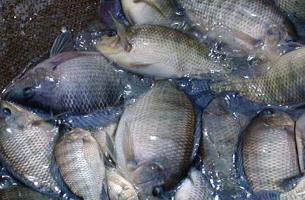
WorldFish’s Genetically Improved Farmed Tilapia (GIFT) program is thought to underpin more than half of the world’s tilapia aquaculture production. WorldFish asked AbacusBio to prepare a business plan for taking GIFT into Nigeria with a local partner, in a way that reaches smallholder farmers and helps pay for the breeding program.
The challenge
WorldFish started the GIFT program in the early 1990s. It now wants new ways of working with public and private partners that keep quality genetics flowing to the aquaculture industry while earning enough to sustain the breeding program.
Nigeria is a large opportunity. The country eats more than 1.5 million tonnes of fish a year, but produces only about 450,000 tonnes itself and imports the rest. Catfish dominates aquaculture, at 264,000 tonnes in 2019. Tilapia aquaculture is small, at around 7,000 to 10,000 tonnes a year.
Tilapia farming is held back by poor access to good seed, affordable feed and management know-how. Nigeria has no tilapia genetic improvement programs. Broodstock is imported and is often falsely sold as “GIFT”. In smallholder systems, tilapia currently looks much less profitable than catfish.
WorldFish had identified PAL, a subsidiary of the Stallion Group, as its preferred partner. It needed a plan that would build PAL as a national multiplication centre without making the relationship exclusive, protect the GIFT brand, and be simple enough to repeat in other countries.
Our approach
We worked in two phases, followed by a financial forecast and an action plan.
1. Industry and market assessment
We estimated the current tilapia fingerling market and projected it forward 20 years. Using a 72% survival rate to a 500g harvest weight, we calculated that one tonne of output needs 2,768 fingerlings. On 2020 production of 7,000 tonnes, that is about 19.4 million fingerlings a year. Only 36% of these (6.9 million) come from commercial hatcheries.
We then modelled three growth scenarios (base, moderate and fast) across two periods, 2020 to 2030 and 2031 to 2040. The fast scenario was set as a realistic upper bound, based on Egypt’s tilapia industry growing at 16% a year since 2006. We also assessed the main market risks.
2. Evaluation of commercialisation models
We described seven ways WorldFish could work with PAL: direct export, indirect export, a subsidiary company, a joint venture, a strategic alliance, licensing and franchising. We found real-world aquaculture examples of each.
With WorldFish, we agreed seven criteria: sustainable return, ease of replication, strategic alignment, flexibility, brand protection, complexity and risk. WorldFish weighted all criteria equally. We ranked each model against each criterion and summed the ranks (lowest score = best rank).
3. Financial forecasts
We estimated what GIFT is worth to Nigerian farmers, what share of that value WorldFish could reasonably collect as a royalty, and what the royalty stream could be worth over 20 years. We tested the royalty stream results against market share, royalty level and royalty growth.
What we found
The market could grow a lot. By 2040, fingerling demand ranged from 36 million a year (base) to 294 million (fast). That is a market worth between US$1.7 million and US$13.9 million a year at current prices. Under the moderate scenario, demand reaches 30 million fingerlings in five years and 45 million in ten.
PAL could meet early demand. With planned expansion, PAL could produce about 13.25 million fingerlings a year. If GIFT’s market share stays below 50% at first, PAL could supply most of the early demand on its own.
Licensing scored best. Licensing ranked highest, ahead of indirect export and a subsidiary company. Licensing is fairly passive, keeps complexity and risk low for WorldFish, can use a largely standard agreement in each market, and can use sub-licences to reach more multiplication hatcheries. Subsidiaries and joint ventures scored well on control but carried too much complexity and risk for a not-for-profit research organisation.
GIFT adds real value per fingerling. Assuming a conservative 20% yield advantage, GIFT could add about ₦22 per fingerling in pond culture and ₦33 in cage culture. Current fingerlings sell for ₦17 to ₦20. To keep GIFT affordable for smallholders, we priced its value at ₦20 per fingerling, left half with farmers, and assumed a royalty to WorldFish of ₦5 per fingerling.
The royalties are worth pursuing. With 50% market share reached in five years, a three-year royalty-free start and a 5% discount rate, annualised royalties ranged from about US$142,000 to US$647,000 a year across the three scenarios. Across the full sensitivity range of market share, royalty level and royalty growth, the top figure was about US$1.63 million. WorldFish estimated the breeding program’s base cost at US$1.75 million a year. If the royalty value grows over time, Nigerian royalties could cover up to 93% of that cost.
The risks are mostly about adoption. The risks include protecting the GIFT brand from look-alike strains, smallholders’ limited technical and commercial skills, competition from catfish and cheap imports, lower yield gains under poorer farm conditions, and exchange-rate risk.
Recommendations
We recommended that WorldFish pursue licensing with PAL, and set out a five-step action plan:
- Develop a concept model. Define the revenue model and a basic license, including how fingerling sales are measured and royalties collected, and how misuse of GIFT is controlled.
- Engage PAL formally and carry out due diligence. Discussions so far had been early and high level. WorldFish needed to understand PAL’s needs, confirm it supports wide dissemination and brand protection, and test its suitability as a partner.
- Consult stakeholders. Test the license model with internal stakeholders, other potential licensees and the market, including views on GIFT’s value and pricing.
- Plan adoption support. Scope and cost an industry support project: new multiplication hatcheries, technical advice for hatcheries, a technology transfer package for farmers, and train-the-trainer programs.
- Make a Go/No-Go decision before starting final legal and commercial due diligence.
If licensing proves unsuitable, indirect export, a joint venture or a strategic alliance are the recommended alternatives.
What happens next
The report sets out a path rather than a final decision. Once the first four actions are complete, WorldFish can decide whether to proceed. It will then have a clear license model, stakeholder feedback, a costed support plan and an understanding of its own financial targets.
Read the full report: Business plan for marketing genetically improved farmed tilapia (GIFT) in Nigeria, prepared by AbacusBio for WorldFish.
How we can help
AbacusBio helps breeding programs, research organisations and agribusinesses take genetic improvement to market, using market assessment, commercial model evaluation and financial forecasting. If you’re planning how to commercialise or disseminate improved genetics: talk to our team