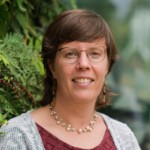
If the world had been a slightly different place, New Zealand would be Anouk Schurink’s home now. It was April 2020 in The Netherlands, and she had sold most of her household items, had completed the lease on her flat, her flights were booked and her visa had been granted. Her new role with AbacusBio had her jet setting to Dunedin, New Zealand. Then the COVID lockdown kicked in globally, and fate would have it that she was to work her consultancy role from Scotland.
She described it as a really interesting period, all quite insecure.
“You can see how quickly life can change.”
Anouk’s role with AbacusBio has remained, but home for this Dutch scientist is in the village Carrbridge, in the Scottish Highlands with a population of around 800 people.
“It’s really rural and community-driven. I own a house here, I love it, it’s home now.”
In her spare time Anouk very much enjoys hiking, describes herself as a “100% amateur wildlife photographer,” and loves to dance Latin & Ballroom, and has recently taken up street dancing.
What first sparked your interest in breeding and genetics?
It was a high school project on Mendel’s Laws while learning about the inheritance of flower colours, in The Netherlands. I learned that you could predict DNA patterns from looking at the colours. But, for many traits we focus on in animal and plant breeding, it is much more challenging to do this prediction I learnt since.
You’ve visited India a couple of times this year to work with rural communities on their breeding programmes, tell us more about that.
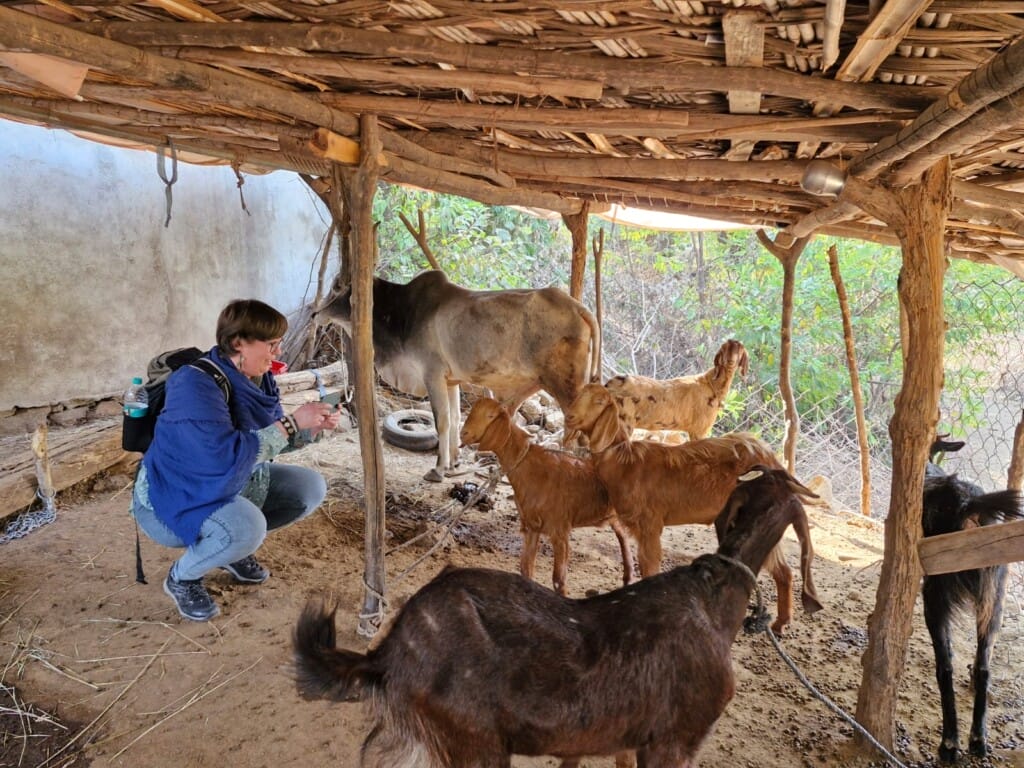
Yes. I’ve been to India with AbacusBio to work on Community Based Breeding Programmes (CBBPs). The first visit at the beginning of the year was to work on Project Climate Change Mitigation Initiative Managed and Led by Women Farmers (CCMIM-LWF) with colleague Doug Bjelland. This project is financed by Tata Trusts and run by Centre for microFinance and Collectives for Integrated Livelihood Initiatives. During our visit we supported the goat CBBPs that started back in 2024 in the states Gujarat and Rajasthan. We visited many villages and consulted goat keepers and field teams on challenges they are facing. We also made a start with developing a Selection Merit Score that recently has been introduced in the programmes. This Score identifies genetically superior bucks based on records like weight, birth type, and various traits measured on the bucks’ mothers.
During the second visit this year Peter Amer and I visited the same CBBPs. We also had an exposure visit to the state of Karnataka, where we learnt about the goat and sheep production chain and current practices to be able to advise about directions for a future CBBP in this state. Where Gujarat and Rajasthan are mostly focussed on keeping a few goats per household, big flocks of sheep kept by herders dominated the market in Karnataka. Considering such differences, CBBPs need to be tailored to the specifics of a region.
What are the benefits of CBBPs?
These CBBPs are really about empowering women in poor rural communities, as they mostly take care of the goats. Pashu Sakhis (“friends of animals”) are local women who are trained and get paid to take various recordings on these animals and are therefore crucial to these CBBPs. Based on these records and the Selection Merit Score, the superior bucks can then be used around the different villages, passing on their good genes for faster growth rate, overall better health, and other traits to the next generations. This means more income for the households as they can sell heavier and possibly even more goats. It’s about making a difference. These goats are owned by poor people, they are like an ATM machine, sold for rupees when the need arises.
What role does DTreo play in these projects?
Without DTreo it would not be possible to run these CBBPs. Performance records and pedigree information of tens of thousands of goats and sheep are kept within the software system.
DTreo also provides good reports and great visualisations of data. It’s one thing to have records or data, another to be able to use it to manage breeding programmes. So it’s important we can provide for instance good visual summaries, track targets, and instantly identify breeding candidates, even in the field.
A recent extension of DTreo is capturing methane emissions so it’ll be possible to select for animals that produce less methane in the future, reducing emissions from small ruminants. Technical work on the Global Methane Hub funded project ‘Low-methane genetics expansion to small ruminants in Africa and Asia’, a collaboration with ICARDA, will commence soon. During this project, methane will be measured on thousands of small ruminants through established CBBPs. With data recorded in DTreo.
We will work closely with our long-term collaborators from the Nimbkar Agricultural Research Institute (NARI) on methane recording and genotyping activities in India.
An initial important step is identifying a protocol of how to measure methane in a CBBP setting, where things won’t be straight forward and set up like we’re used to in big commercial farms.
What is your role/job with DTreo?
To figure out what is required by the client, for example what records do they want to capture. I make sure the wishes of the clients are translated into DTreo features, including reports and tools like the Selection Merit Score.
I need to have a high level of understanding of what is needed. Our excellent DTreo development team subsequently translates these requirements into a customized tenant.
Women empowerment is an important part of these projects?
Absolutely. Project Mesha, a goat CBBP in the state Bihar, has been running for about nine years now. Through a survey that was conducted as part of the project we received lots of messages of empowerment and increased incomes. Some of the Pashu Sakhis became buck entrepreneurs, selling matings of these superior males within their communities.
Helping these poor women and households makes me feel like I am making a real difference, having a positive impact on their livelihoods. That is my small piece I can add to it.
Having previously spent four months in India and Nepal solo travelling, I got to experience an exposing but worthwhile trip. You must be aware of and adjust to cultural differences.
You try and see the beautiful things…
During our April visit we got invited into someone’s home. It is very touching that they shared a big papaya with us, even though they have little.
The warm welcomes and laughter and singing during our visits to these rural villages is something I will never forget. And we might leave a lasting impression as well, besides the genetic improvement of small ruminants. Traveling by plane through different timezones and not being married at the age I am at were difficult to grasp, and would, according to the field teams, keep the women talking for weeks.
You can reach Anouk at aschurink@abacusbio.com
Keep up to date with AbacusBio news, by subscribing to our newsletter HERE and following us on LinkedIn, Facebook and Bluesky